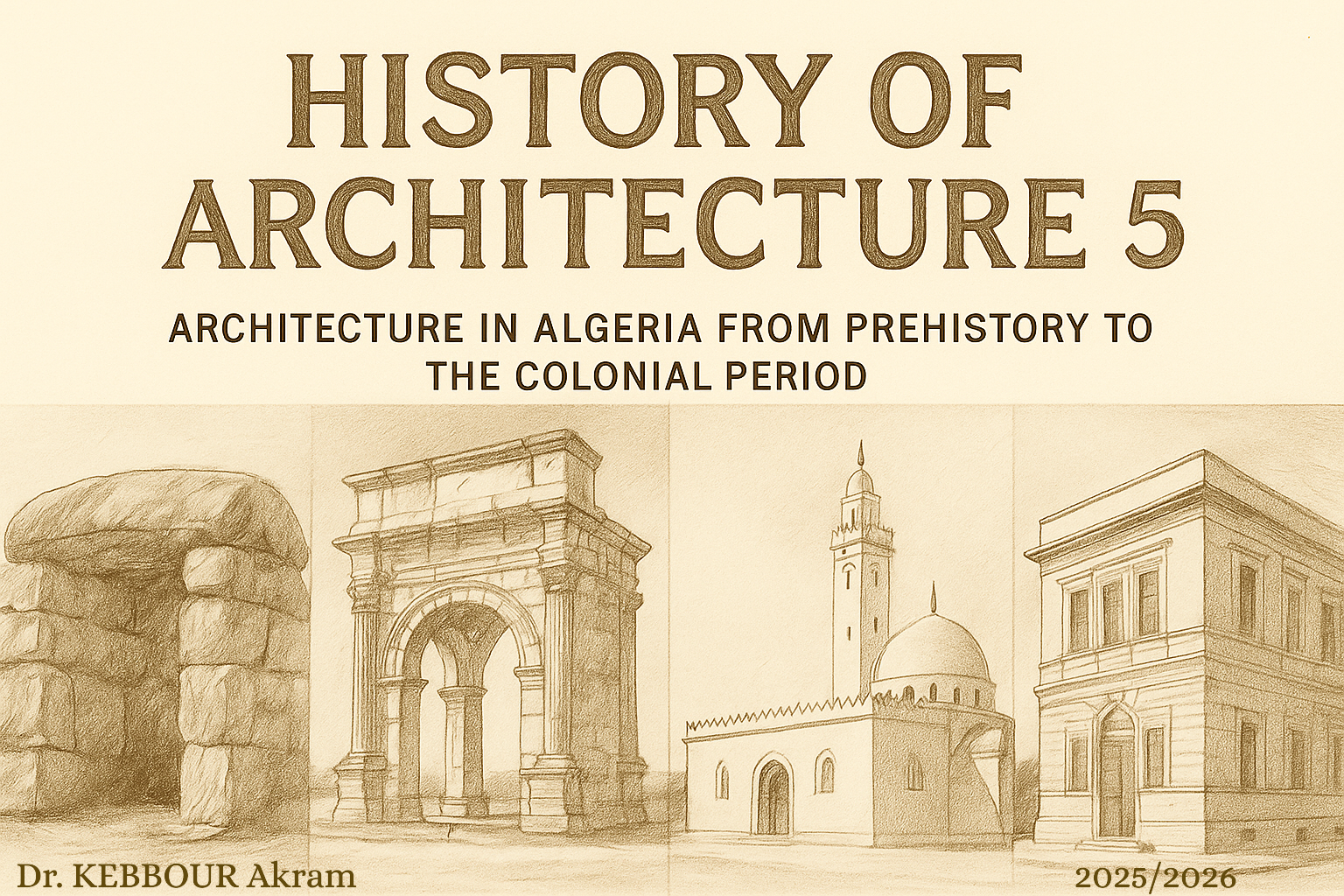
This course aims to introduce students to the history of Algerian architecture, focusing on its local roots. Understanding the development of architecture in our country means above all discovering the cultural, social and historical influences that have shaped it over time.
Studying this history not only gives us a better understanding of the specific features of our built heritage, but also raises awareness among future architects of the importance of preserving it. By familiarising themselves with the works, techniques and contexts that have left their mark on Algerian architecture, students will develop an awareness of heritage that is essential to any project approach in the local context.
Finally, this course is also a gateway to a better understanding of Algerian cultural identity. It offers students the opportunity to reconnect with their heritage, to become aware of their role in society and to envisage more relevant architectural interventions, respectful of the past and in tune with contemporary realities.
- Teacher: Akram KEBBOUR
Project Theory 5 (Théorie de Projet 5) is a fundamental, 5th-semester course designed to bridge abstract theoretical knowledge with concrete design methodology, preparing students for advanced studio practice. The course is structured around a four-phase conceptual arc: beginning with the phenomenological understanding of Lived Space, transitioning into the Cognitive Process of Creation , and formalizing the abstract idea into the strategic Parti. The final phase focuses on Organization and Critique, teaching students the geometric rules of Spatial Organisation (Axis, Grid, Hierarchy) and the Tectonic articulation of elements, while critically examining the ideological drivers and the socio-spatial dialectic between conceived space and lived space. The core objective is to equip students with the conceptual tools and critical thinking frameworks necessary to translate intuitive intentions into coherent, structured, and methodically informed architectural solutions.
- Teacher: Mohammed LAMINE